Streaming Bundle Strategies: How 3 Platforms Cut Costs in 2026
Latest developments on streaming bundle strategies aimed at offering up to 25% savings by 2026 are dominating industry discussions. This analysis provides key facts, verified insights, and what consumers need to monitor in the evolving streaming landscape. The focus is on major players and their innovative approaches to subscriber retention.
Streaming bundle strategies, particularly how 3 major streamers are offering up to 25% savings in 2026, are rapidly reshaping the entertainment industry. This shift reflects a concerted effort by platforms to combat subscription fatigue and enhance consumer value. As the market matures, bundling emerges as a crucial tactic for both subscriber acquisition and retention.
The move towards aggregated content offerings is not merely a pricing adjustment; it represents a fundamental re-evaluation of business models in a highly competitive sector. Consumers stand to benefit significantly, with projections indicating substantial savings on their monthly entertainment expenses. Understanding these strategies is key to navigating the future of digital content consumption.
The Rise of Streaming Bundle Strategies in a Saturated Market
The streaming landscape is increasingly crowded, with numerous platforms vying for consumer attention and subscription dollars. This intense competition has driven innovation, pushing companies to explore new ways to differentiate their offerings and provide compelling value propositions.
As subscriber growth for individual services begins to plateau, the focus is shifting towards maximizing lifetime value and reducing churn. Bundling, long a staple in other industries, is now becoming a central pillar of these efforts. It represents a strategic pivot designed to consolidate market share and offer a more integrated entertainment experience.
Early indicators suggest that these streaming bundle strategies are resonating with consumers, who are eager to simplify their subscriptions and unlock greater savings. The promise of up to 25% off by 2026 is a powerful incentive, driving widespread interest and adoption across various demographics.
Major Players Leading the Charge in Bundle Innovation
Several industry giants are at the forefront of implementing aggressive streaming bundle strategies. These companies possess the content libraries and market reach necessary to create attractive multi-service packages. Their moves are setting a new standard for the entire sector.
Disney, for instance, has successfully leveraged its extensive portfolio, including Disney+, Hulu, and ESPN+, to offer compelling bundles that cater to diverse tastes. This integrated approach allows them to cross-promote content and retain subscribers across multiple platforms, effectively reducing churn.
Other major players, while not yet publicly announcing specific 25% savings for 2026, are clearly signaling their intent to follow suit or innovate further. The competitive pressure ensures that such aggressive pricing and bundling will become a norm rather than an exception, benefiting consumers significantly.
Understanding the Economic Drivers Behind Bundled Offers
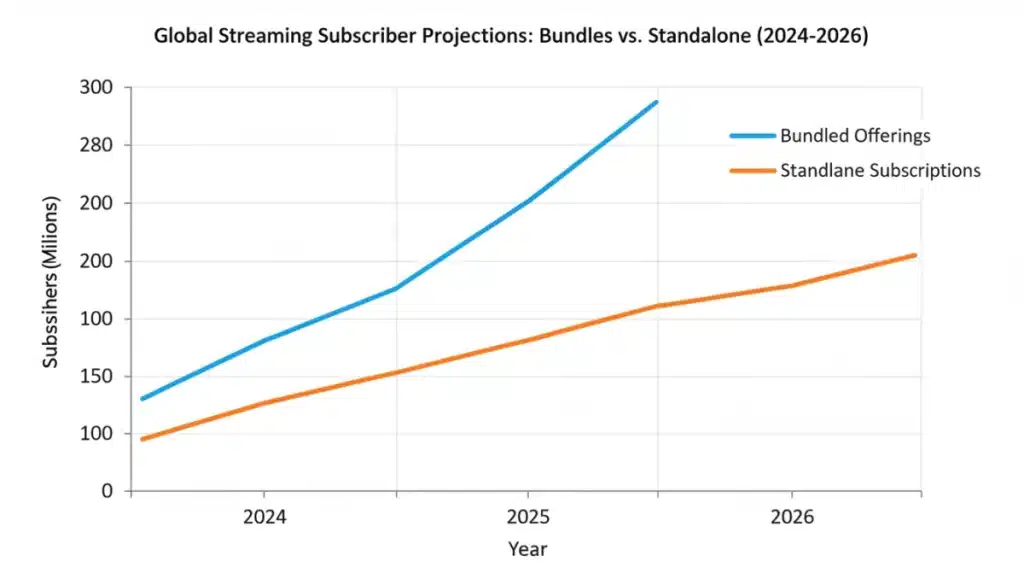
Projected growth of streaming bundle subscriptions versus individual services.
The decision to implement extensive streaming bundle strategies is rooted in clear economic imperatives for streaming providers. These strategies are designed to address several critical challenges facing the industry, from rising content costs to subscriber churn.
By offering bundles, companies can increase their average revenue per user (ARPU) while simultaneously providing perceived value to the consumer. It’s a delicate balance that aims to optimize profitability while maintaining a competitive edge in a price-sensitive market. The economies of scale achieved through bundling also allow for more efficient content licensing and distribution.
Moreover, bundled subscriptions can act as a powerful deterrent against cancellations, as consumers are less likely to unsubscribe from a package that offers multiple services at a discounted rate. This sticky subscriber base is invaluable in an industry where retention is as crucial as acquisition. These streaming bundle strategies are not just about discounts; they are about long-term business sustainability.
The Role of Subscriber Acquisition Costs
Acquiring new subscribers is an increasingly expensive endeavor for streaming services. Marketing spend, content production, and promotional offers all contribute to high customer acquisition costs (CAC). Bundles offer a more efficient pathway to bring new users into an ecosystem.
When a customer subscribes to a bundle, they are effectively joining multiple services with a single acquisition effort.
This significantly lowers the blended CAC across the bundled platforms. It’s a win-win: consumers get more content for less, and streamers gain subscribers more cost-effectively.
Churn Reduction and Customer Lifetime Value
High churn rates remain a significant concern for standalone streaming services. Consumers often subscribe for a specific show or movie, then cancel once they’ve consumed that content. Bundles combat this by offering a broader, more diverse content library.
A diversified content offering within a bundle provides more reasons for a subscriber to stay, increasing their customer lifetime value (CLV).
The interconnectedness of services within a bundle makes it harder for consumers to justify canceling, as they would lose access to multiple platforms simultaneously. This plays a vital role in the success of streaming bundle strategies.
Projected Consumer Savings and Market Impact by 2026
The promise of up to 25% savings through streaming bundle strategies by 2026 is a game-changer for consumers. This significant discount translates into substantial annual savings, making premium content more accessible and affordable for households.
Industry analysts project that these savings will drive increased adoption of bundled services, potentially shifting market share away from standalone subscriptions. Consumers will likely prioritize packages that offer the best value and content diversity, influencing future content production and licensing decisions.
The long-term impact extends beyond individual savings, fostering a more consolidated and potentially less fragmented streaming ecosystem. This could lead to fewer individual subscriptions but more comprehensive entertainment packages, fundamentally altering how audiences engage with digital media. These streaming bundle strategies are setting a new industry standard.
Technological Innovations Enabling Seamless Bundling
The success of advanced streaming bundle strategies relies heavily on underlying technological infrastructure. Streamers are investing in sophisticated platforms that can seamlessly integrate multiple services, manage complex billing, and provide a unified user experience.
This includes developing single sign-on capabilities, personalized content recommendations across bundled services, and streamlined customer support. The goal is to make the bundled experience feel cohesive and intuitive, rather than a patchwork of disparate applications. These innovations are critical for user satisfaction and retention.
Furthermore, data analytics play a crucial role in understanding consumer preferences and optimizing bundle offerings. By analyzing viewing habits across multiple services, platforms can tailor bundles to specific demographics and maximize their appeal, ensuring the long-term viability of these streaming bundle strategies. The technological backbone is as important as the content itself.
Unified User Interfaces and Discovery
One of the biggest challenges with bundling is preventing user friction when navigating multiple services. Streamers are addressing this by developing unified user interfaces or discovery hubs that allow subscribers to browse content from all bundled platforms in one place.
This seamless integration enhances the user experience, making it easier for viewers to find what they want to watch without constantly switching between apps.
Improved content discovery is a key driver of engagement and value perception for bundled offerings, a core component of effective streaming bundle strategies.
Advanced Billing and Account Management
Managing multiple subscriptions can be cumbersome for consumers. Bundles simplify this by consolidating billing into a single monthly payment.
However, the backend infrastructure for this needs to be robust, handling prorated charges, promotions, and potential cancellations across services.
Automated systems for account creation and management are essential to ensure a smooth onboarding process and minimize administrative overhead.
The complexity of these systems is significant, but their effective implementation is vital for the operational success of any major streaming bundle strategies.
Challenges and Considerations for Streamers and Consumers
While streaming bundle strategies offer significant advantages, they also present challenges for both providers and consumers. Streamers must carefully balance pricing, content rights, and partnership agreements to create sustainable and attractive bundles.
For consumers, the primary challenge might be choosing the right bundle that aligns with their viewing habits and budget. Too many options, or bundles with unwanted services, could lead to confusion or perceived lack of value. Transparency in pricing and content offerings will be crucial for consumer trust.
Moreover, the exclusivity of certain content remains a competitive differentiator. Streamers must decide which content to reserve for their standalone services and which to include in bundles, impacting the overall appeal and competitive positioning of their offerings. Navigating these complexities will define the success of future streaming bundle strategies.
Legal and Regulatory Landscape for Bundling
The expanding adoption of streaming bundle strategies also brings into focus the legal and regulatory implications. Antitrust concerns, particularly regarding market dominance and potential anti-competitive practices, may arise as major players consolidate their offerings.
Regulators will be closely monitoring these developments to ensure fair competition and protect consumer interests. Transparency in pricing, contract terms, and cancellation policies will be key areas of scrutiny. The legal framework surrounding these bundles is still evolving, mirroring the rapid pace of technological change.
Furthermore, international variations in intellectual property rights and content licensing agreements add another layer of complexity. Streamers must navigate a labyrinth of global regulations to offer consistent and legally compliant bundles across different regions, impacting the reach and availability of certain streaming bundle strategies. This global aspect cannot be overlooked.
The Future of Content Consumption: Beyond 2026
Looking beyond 2026, the evolution of streaming bundle strategies is expected to continue, potentially leading to even more integrated and personalized content ecosystems. The lines between traditional linear television and on-demand streaming will blur further, with bundles playing a central role.
We may see the emergence of highly customizable bundles, allowing consumers to pick and choose specific channels or content categories rather than entire services. Artificial intelligence and machine learning will likely drive these personalization efforts, creating bespoke entertainment packages for each user. The industry is constantly adapting.
Ultimately, the long-term vision is to create an entertainment experience that is both highly convenient and incredibly cost-effective for the consumer. The current push towards 25% savings by 2026 is just one significant step in this ongoing transformation of how we consume media. These innovative streaming bundle strategies are here to stay and evolve.
| Key Point | Brief Description |
|---|---|
| 25% Savings by 2026 | Major streamers aim to offer significant discounts through bundled subscriptions. |
| Market Consolidation | Bundles drive subscriber retention and reduce churn in a saturated market. |
| Technological Integration | Seamless UI, billing, and content discovery are crucial for bundle success. |
| Consumer Benefits | Access to diverse content at a lower overall cost, simplifying subscriptions. |
Frequently Asked Questions About Streaming Bundle Strategies
Streaming bundle strategies involve offering multiple streaming services together as a single subscription package, usually at a discounted rate compared to subscribing to each service individually. This aims to attract new subscribers and retain existing ones by providing enhanced value and convenience.
Companies like Disney (with Disney+, Hulu, ESPN+), and others are actively developing and expanding their bundled offerings. While specific details for all major players for 2026 are still emerging, the trend points towards broader industry adoption of these comprehensive packages.
Industry projections suggest that consumers could see savings of up to 25% on their streaming subscriptions by opting for bundles by 2026. These savings are a key incentive for consumers to consolidate their entertainment spending and simplify their monthly bills.
For streamers, bundles help reduce customer acquisition costs, lower churn rates, and increase customer lifetime value. They also allow for cross-promotion of content across different services within the bundle, fostering a more engaged and loyal subscriber base.
Bundles could influence content exclusivity strategies. Streamers must decide which content to keep exclusive to individual platforms and which to include in bundles. This decision will impact the perceived value of both standalone services and the bundled offerings in the competitive market.
Looking Ahead: The Evolving Landscape of Streaming Subscriptions
The acceleration of streaming bundle strategies marks a pivotal moment for the entertainment industry. The promise of significant savings by 2026 underscores a broader shift towards consumer-centric models designed for retention and value.
As these bundles become more sophisticated, driven by technological advancements and market competition, consumers can anticipate a more integrated, cost-effective, and personalized streaming experience.
The evolution of these offerings will continue to shape how we access and enjoy digital content for years to come, moving beyond simple discounts to comprehensive entertainment ecosystems.